AI helps with hiring when you use it where it is genuinely reliable and build it on a sound foundation. It is excellent at language: drafting, summarizing, sorting through more applications than any human could read in a week. It is far weaker at judgment. So the honest answer is that AI earns its place when a person stays in the loop, and when the very first input, the job description, is right. Get that right and good inputs compound into stronger decisions. Get it wrong and AI carries the flaw all the way through your funnel.
Here is where it helps, where it hurts, and how to keep it on the right side of that line.
Where AI genuinely helps
Large language models are extraordinary with words. They read something long and give you the gist in seconds. They draft, rephrase, summarize, and spot patterns across far more text than you could get through in a day, without getting tired or bored.
That is why adoption has moved so fast. 69% of HR teams now use AI somewhere in recruitment, up from 51% a year ago, and that is on track to reach 81% within twelve months.¹ The time savings are real, which is exactly why the risks underneath are easy to miss.
Where AI quietly hurts
Fluent is not the same as right. An LLM is, at heart, a very sophisticated prediction machine: it writes the most plausible next few words. Most of the time that lands well. Some of the time it is confidently, fluently wrong, and it sounds just as certain either way. It does not understand your business or your role, it cannot tell you when it is out of its depth, and it carries the biases of the data it learned from.
Left entirely to its own devices, that is the real problem. Unreliable AI tends to compound risk faster than it delivers the efficiency everyone was promised. It is no surprise that 57% of HR leaders say reliability is the single biggest barrier to trusting AI in recruiting.²
Why the job description decides everything after it
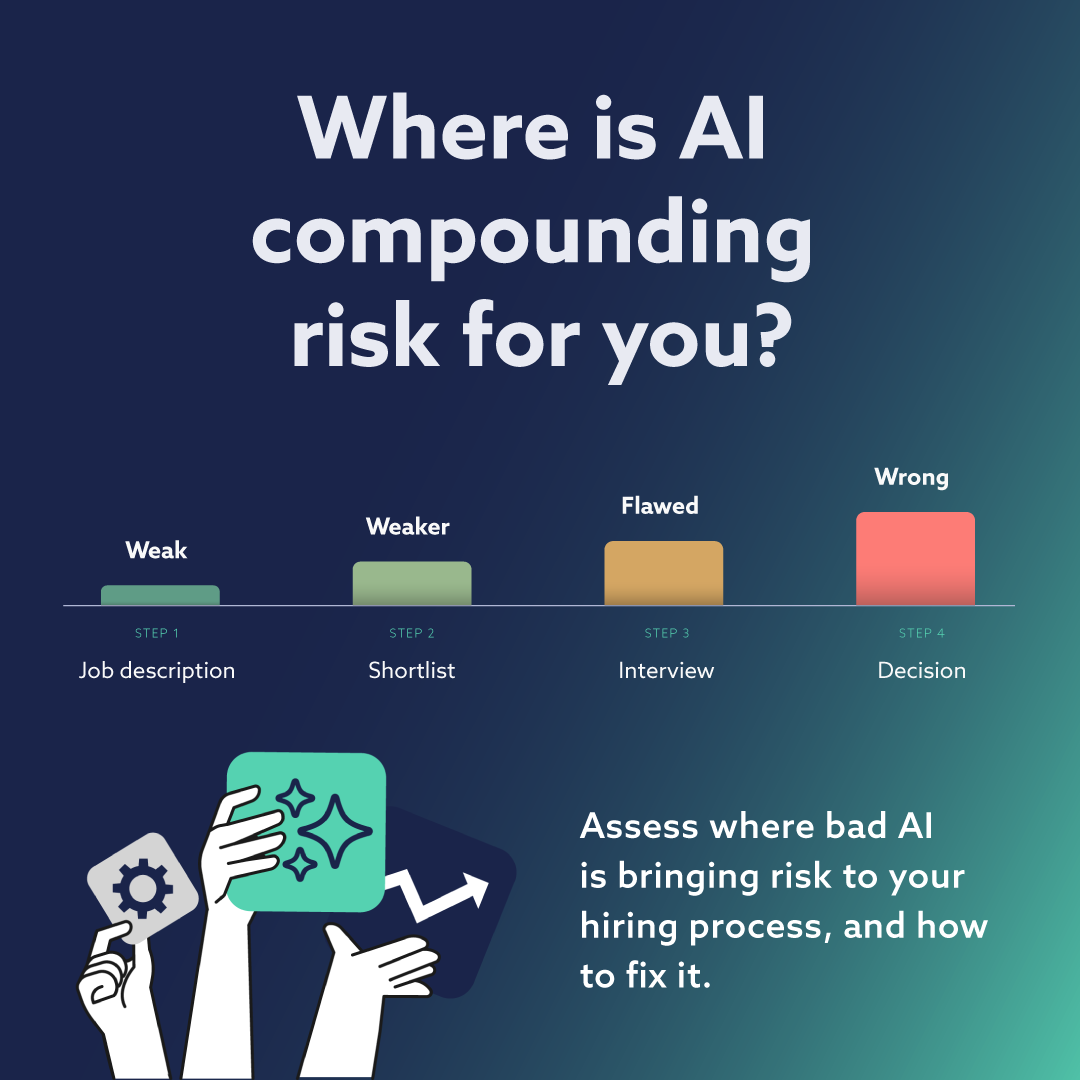
The job description is the seed for everything that follows. A vague or generic one is not an obvious disaster on its own, but screening builds a shortlist from it, you interview off that weaker shortlist, and the final decision, the one that actually costs or creates value, ends up resting on a foundation that drifted at every step. At the scale of thousands of applicants, a small drift moves a lot of people the wrong way. Those fractions do not add up. They multiply.
General-purpose tools like ChatGPT make this worse in a way that is hard to spot. They write for keywords, so they produce something that reads well but quietly leaves out what genuinely predicts success in that specific role. Because it reads well, you rarely notice what is missing.
“AI magnifies weak job descriptions. If your JD doesn’t define what success looks like, AI screening is more likely to miss strong candidates.”
— Barny Ritchley, CTO, Saville Assessment
How to make AI help instead of hurt
There is a simple principle becoming the industry standard: let AI do the heavy lifting where it is strong, and put a person and a guardrail where it is weak. Keep a human in the loop on the decisions that matter. Use AI to assist a judgment, never to replace it. And check what it gives you against something objective and validated, rather than taking its word for it.
The encouraging part is that compounding runs both ways. Tighten the first input and better inputs compound into better decisions, just as powerfully as weak ones compound into worse ones. So the highest-leverage place to start is not somewhere deep in your process. It is the front door.
Start with your job description
Our free AI Job Description Analyzer is built to get that first step right. Paste in any job description, one you wrote or one AI drafted for you, and it maps against the skills and behaviors that genuinely predict success in that kind of role. You get a quality score out of 100 and the top five fixes, with real wording you can use straight away.
It takes a couple of minutes and there is no catch. Run one of your own and see what your current AI is leaving out.
Want the full picture of where AI is compounding risk across your funnel, and the science that keeps your talent data clean? Our report Confidently Wrong walks through it stage by stage.
Common questions
Is AI good for hiring?
AI is good at the language-heavy parts of hiring, like drafting and summarizing, and poor at judgment. It helps when a person reviews its output and the underlying inputs are sound, and it hurts when it is left to run unchecked.
Can AI write a job description?
It can write one that reads well in seconds, but general-purpose AI writes for keywords rather than for what predicts success in the role, so it often leaves out the competencies that matter most. Have it drafted, then check it against a validated model before you post it.
What are the biggest risks of using AI in hiring?
Inconsistent results, invented or misheard detail passed on as fact, and inherited bias from past data. Because each stage feeds the next, small errors early on compound into decisions you cannot stand behind.
Sources
¹ SHRM / Gartner research on AI adoption in HR and recruitment.
² Fosway Group, Talent Acquisition Realities, Interim Results, RecFest 2026.